


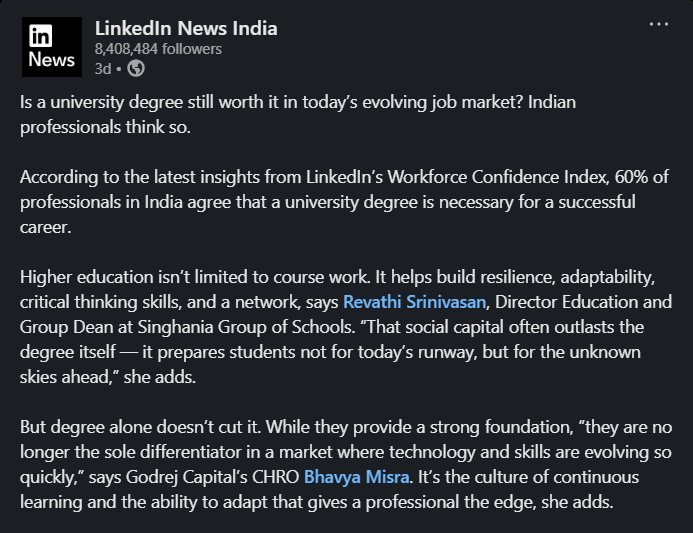
Is a university degree still worth it in today’s rapidly evolving job market? According to the latest insights from LinkedIn’s Workforce Confidence Index, a significant 60% of professionals in India believe that a university degree remains necessary for a successful career. However, in this era of fast-changing technologies and skills demands, the debate between traditional degrees and practical skills is more relevant than ever.
Contents
The Value of a Degree: Beyond Just the Coursework
While degrees have long been considered the cornerstone of professional success, higher education today offers much more than academic knowledge. As Revathi Srinivasan, Director Education and Group Dean at Singhania Group of Schools, puts it:
“It helps build resilience, adaptability, critical thinking skills, and a network. That social capital often outlasts the degree itself — it prepares students not for today’s runway, but for the unknown skies ahead.”
In other words, a degree equips students not just with facts but with lifelong skills and relationships that aid their ongoing career journey.
Degrees Alone No Longer Differentiate
At the same time, the evolving job market demands more than just academic credentials. Bhavya Misra, CHRO at Godrej Capital, highlights that “while degrees provide a strong foundation, they are no longer the sole differentiator in a market where technology and skills are evolving so quickly.”
Continuous learning and adaptability have become the critical factors that give professionals a competitive edge.
Skills-first hiring expands opportunities by significantly broadening talent pools. LinkedIn data shows that in India, skills-first hiring increases the available candidate pool by 11.4 times. In particular industries like real estate and equipment rental services, this approach amplifies potential candidates by as much as 86.4 times.
Balancing Degrees and Skills for Inclusive Hiring
Removing degree requirements from job descriptions can unlock hidden talent and bring diversity to organizations. Misra remarks,
“Broadening criteria allows recruiters to consider talent from unconventional sources, ensuring a fair evaluation of the skills most in demand. Valuing skills, experiences, and potential alongside academic qualifications ensures a more inclusive workforce and prevents missing out on individuals who can deliver impact.”
This balanced perspective signals a promising shift in hiring—where degrees open doors, but skills and practical capabilities keep professionals in the game.
Universities Are Adapting to the New Norm
In response to changing employer expectations, universities are evolving their curricula. Srinivasan notes that institutions are integrating experiential learning, cross-disciplinary exposure, and communication training to “hardwire adaptability so graduates can thrive and even redefine the future of work.” Graduates emerging from this skills-infused education system will be better prepared to meet real-world challenges.
Join the Conversation
➡️ Is a university degree still a vital differentiator in today’s job market? Share your thoughts and experiences in the comments below.
References and Credits
- LinkedIn Workforce Confidence Index based on a survey of 1,018 Indian LinkedIn members, conducted June 2025
- Insights by Revathi Srinivasan, Bhavya Misra, Allie Lewis, Silvia Lara, Dipal Desai, Priyanka Rathod, Rakshit Ravindranathan
For detailed information, visit LinkedIn’s official news post: Degree or skills — what matters more?

